Stateful Versus Stateless Agent Architecture Tradeoffs
Choose between simple scaling or cheap tokens, but you can't have both.
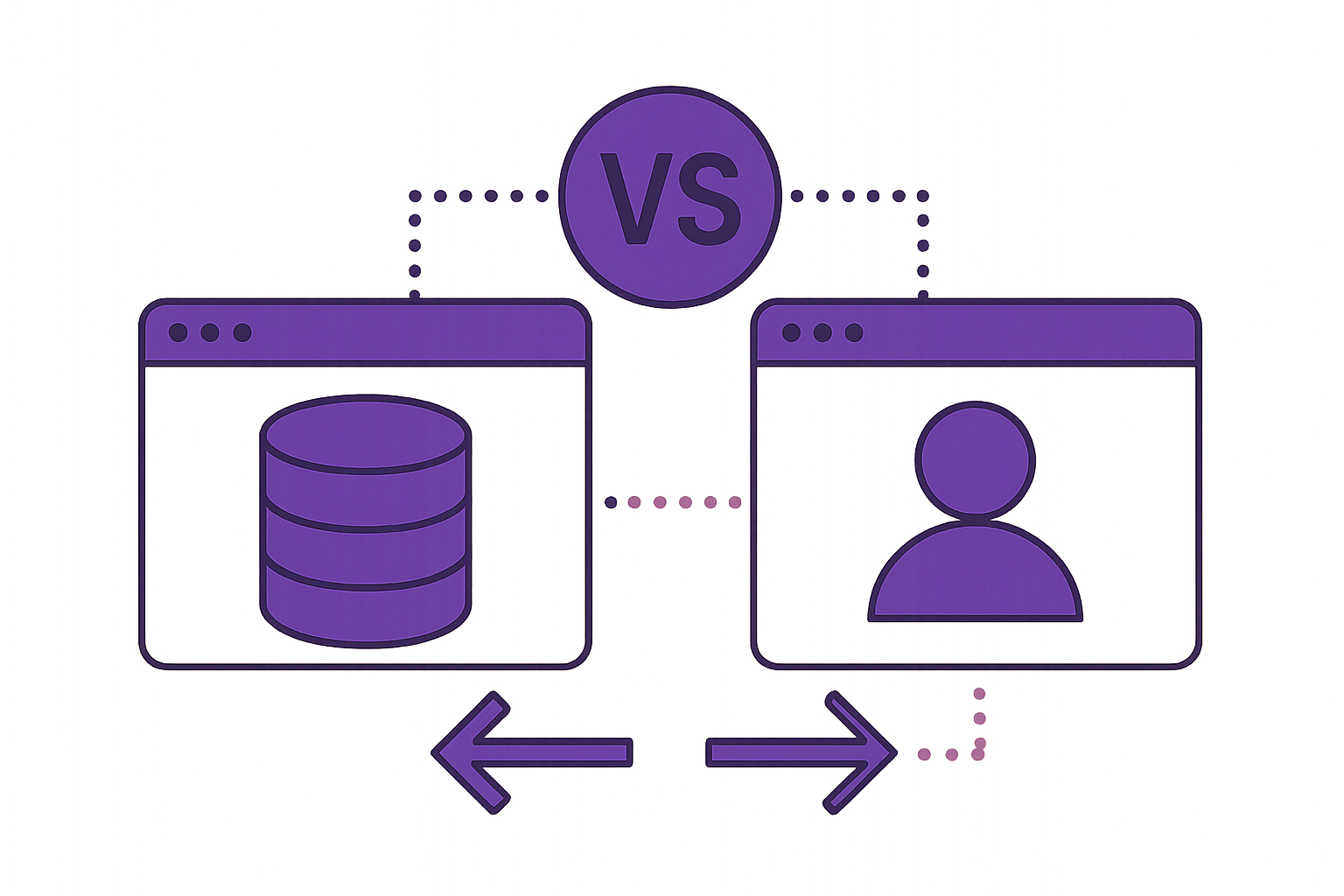
Every large language model, whether it's GPT-4, Claude, or Llama, forgets everything the moment it finishes generating a response. That's the whole architecture. What looks like memory in a chat interface is an illusion built entirely on the client side: your code resends the full conversation history with each new call, and the model reconstructs context from scratch every time. Stateful versus stateless comes down to where memory physically lives, and that choice carries real cost, real failure modes, and real consequences for what an agent can and can't do.
A stateless agent treats every request as a closed transaction, where input comes in, a prompt gets built, the model responds, and nothing survives past that response. No session lookup, no persistence, no record. A stateful agent does something structurally different. Before it builds a prompt, it reads prior state from an external store, a Redis cache, a Postgres table, or in early prototypes just an in-memory dictionary, and after the model responds, it writes the updated state back. That extra loop, read before, write after, is the entire distinction; its presence or absence determines the costs, the bugs, and the scaling headaches downstream.
What stateless agents do well
Stateless architecture earns its keep through operational plainness. Because no server-side session ties a request to a particular instance, any server can handle any request. Load balancing turns into a solved problem: round-robin across a fleet, no sticky sessions, no coordination overhead between instances. For teams running high-throughput inference at scale, a simple deployment stays simple only under this architecture; otherwise it becomes genuinely complicated.
The implementation stays lean too. A stateless handler behaves close to a pure function: no schema design, no serialization logic, no consistency handling between reads and writes. Nobody maintains a store, so nobody debugs one either. For high-throughput, low-latency workloads, that absence of overhead is the whole appeal.
Stateless inference is also the only pattern that can guarantee the runtime writes zero conversation data to disk, which matters under EU data-residency rules and under contracts that specify zero retention. Nothing persists, so nothing leaks, nothing gets subpoenaed, nothing sits on a disk waiting to violate a regulation.
The enthusiasm should stop there, though. Stateless design solves the infrastructure cleanly and says nothing about the cost it quietly creates elsewhere, which turns out to be the more expensive one once a workload runs past a couple of turns.
The hidden cost of statelessness: how context window growth becomes a billing problem
In a multi-turn stateless conversation, the client has to resend the entire history with every new request, because the model retains nothing on its own. A short prompt goes out in turn one. Turn two sends turn one plus turn two. Turn ten sends nine prior turns plus the new one. The context window doesn't grow with turn count, it grows with the compound sum of every turn that came before it, and that snowballing is exactly where cost modeling goes wrong.
Teams that estimate cost per turn, treating each exchange as an independent, similarly priced unit, will underprice multi-step agentic workflows by a factor of three to five. That's not a rounding error in a budget spreadsheet. A viable margin depends on it; without it, the product is quietly unprofitable.
Scale makes the mistake worse. Frontier model input pricing runs $2.50 to $5 per million tokens, and agentic workloads consume anywhere from ten to a hundred times more tokens than equivalent single-turn chat interactions. An agentic loop running ten cycles of reasoning, acting, and reflecting can burn through fifty times the tokens of one linear pass through the same problem, because every cycle re-reads everything that came before it just to figure out where it left off.
The tradeoff sharpens from there: stateless architecture is cheap to build and cheap to run at the infrastructure layer, but expensive at the token layer the moment a task spans more than a couple of turns. The bill appears in the model API invoice instead of the hosting invoice, and it becomes visible late, after the pricing model is already locked in.
What stateful agents require you to build
A stateful agent's request lifecycle reads simply on paper: receive a request tagged with an entity key (a user ID, session ID, or workflow ID), load the stored context for that key, merge it with the new input, call the model and whatever tools it needs, compute the updated state, and write that state back to the store. Six steps, none of them exotic.
The infrastructure behind those six steps is where the real commitment lives: a persistent store has to exist somewhere, session management has to be built, and schema design has to be chosen, and these are the commitments that actually cost teams time and money. A persistent store has to exist somewhere: SQLite works fine for a prototype, but production work generally means Redis or Postgres. Session management has to be built. Schema design has to be chosen for whatever state format the system settles on. Serialization and deserialization have to be handled, and so does consistency, for the moment two operations touch the same record close together in time.
Horizontal scaling, nearly free under the stateless model, gets complicated fast here. Simple round-robin load balancing breaks session continuity, because requests are no longer guaranteed to reach a server that shares the same cached state. Sticky sessions or partitioned stores become necessary, and both introduce their own operational surface area.
Architectural fragmentation is the deeper risk. Production teams building stateful agents often end up assembling a patchwork of disparate stores for different concerns, all stitched together with glue code nobody enjoys maintaining. That fragmentation, not the model, is usually where reliability breaks down in practice. The model does its job fine. Five different stores disagreeing about the current state of the world is what triggers the incident.
The five failure modes that make stateful agents hard in production
Production incident analyses consistently point to two root causes ahead of anything related to the model itself: stale state and lost state on retry. Not hallucination. Not reasoning errors. State management, plain and simple.
Stale state from parallel overwrites is the first and most common pattern. When multiple agents or processes modify shared state concurrently without coordination, whichever write happens to land last survives, regardless of whether it was the logically correct one. Two updates race, one wins on timing alone, and the system has no way of knowing the winner wasn't the right answer.
Partial updates form a second, related failure. A write to the state store gets interrupted mid-operation by a crash, a timeout, or a dropped connection, and the agent is left holding an inconsistent view of its own context. It thinks it knows what happened last turn. It's wrong, and it has no mechanism for detecting that it's wrong.
Race conditions round out the pattern at a slightly larger scale. Agent A writes value X to a shared location at the same moment Agent B writes value Y to that same location, and whichever write lands last simply overwrites the other, with no reconciliation logic in between. This is fundamentally a multi-agent coordination problem, and it gets worse as more agents get added to a system, since every additional writer is another opportunity for the same collision.
None of these failures are exotic distributed-systems trivia. They're the direct, mechanical consequence of persisting state across a system with more than one actor touching it. Statelessness sidesteps all five failure modes by refusing to have shared state. Statefulness accepts them as the price of continuity.
Where the performance gap between architectures shows up (and where it does not)
The performance difference between the two architectures isn't universal, and treating it as if it were misses the actual pattern. On short, atomic tool-use tasks, a single lookup, a single classification, a single API call and response, stateless call patterns hold up fine. There's no continuity to lose, so there's nothing for statelessness to cost.
The gap opens on long-horizon work: extended software engineering tasks, multi-turn dialogue, anything where later steps depend on decisions made many steps earlier. In 2025 and 2026 evaluations, stateful systems have outperformed stateless ones on these tasks by roughly 10 to 30 percentage points, a spread wide enough to change which architecture is defensible for a given product.
τ-bench is the sharpest instrument for this distinction. It simulates customer-service conversations where users lie, contradict themselves, and change their minds mid-conversation. A stateless system, forced to re-derive the current situation from the raw transcript on every turn, loses somewhere between 15 and 25 points against a system that maintains an explicit belief state about what the user actually wants. Re-reading a transcript is not the same operation as tracking a belief, and τ-bench measures that gap.
Microsoft's STATE-Bench found that frontier models score only 26 to 58 percent on long-horizon, state-dependent tasks when they have no external memory to draw on, despite performing far better on short-context work using the identical underlying model. That spread is an architecture gap wearing a model's name.
Real-world evidence lines up with the benchmarks. A 2026 study measuring AI agent task completion across frontier models found completion rates ranging from just 1.7 percent to 24 percent on multi-step office tasks that humans consider entirely routine. The agents in that study weren't failing because they couldn't reason through the steps. They failed because they couldn't keep their internal model of the external world synchronized with how that world actually changed over the course of the task, which is a state problem wearing a reasoning problem's clothes.
Matching architecture to task: the practical decision criteria
Three variables decide this in practice: task complexity, session length, and how much infrastructure the team is actually willing to own and operate.
Stateless is the right default when tasks resolve in one turn or very few. The empirical median for enterprise support tickets stays under four turns, which says something about how rare genuine long-horizon need actually is across a lot of deployed systems. It's also the right choice for deterministic work, classification, extraction, summarization, one-shot question answering, since none of that has an evolving context worth tracking to begin with. Adding zero data retention or strict data-residency requirements moves stateless from merely convenient to close to mandatory. And a team that needs to scale horizontally without taking on session-management infrastructure should treat stateless as the default, not an afterthought.
Stateful earns its cost when sessions run long, span multiple steps, or need to resume after an interruption. Coding assistants, research agents, and complex customer workflows all live here, and none of them work well any other way. Error recovery makes the case even stronger: a stateful agent can log what it already attempted, detect that the attempt failed, and try a different path next time, while a stateless agent fails again with no record that it ever tried anything. Multi-agent coordination all but requires statefulness too, since agent-to-agent interaction is inherently a shared-state problem, the state is the coordination medium, and there's no way around that. Any product built around personalization or an accumulating user profile needs somewhere to keep accumulating it, which rules out stateless by definition.
Most teams don't face a clean either-or choice, and the hybrid pattern, stateless frontends paired with a stateful orchestrator sitting behind them, resolves the tension for a lot of real systems. The edge stays horizontally scalable and cheap to run, handling high-volume, low-complexity traffic the way stateless architecture handles it best. The orchestration layer, doing far less volume but carrying the actual continuity of a task, holds the state that matters. The two architectures were never competing for the same job.