Temporal Workflow Engine for Persistent AI Agent Orchestration
Durable execution prevents AI agent deployments from losing progress when infrastructure fails.
Enterprise agentic AI is scaling faster than the infrastructure meant to hold it up, and that gap, not model quality, is why so many deployments stall out after the pilot stage. The pattern repeats often enough to name: a process restarts and the agent forgets what it was doing, a retry fires without knowing whether the last tool call actually completed, a job that needs forty-five minutes to finish dies the moment a Kubernetes rollout touches its pod. None of that is a model problem. GPT-4 class reasoning or Claude's tool use doesn't degrade when a container gets rescheduled. The orchestration layer around the model does. By mid-2026, most teams running agents at production scale have hit this same wall, and the fix that's emerged is pairing the agent framework with a workflow engine that solved durability years before "agentic AI" became a phrase anyone used.
Three failure modes appear repeatedly in production. A long workflow needs every service in its chain alive for the full duration, so a single timeout partway through means no partial credit, just a restart from zero. A crash mid-activity leaves no way to know if the tool call fired before the crash, and a naive retry sends it twice, harmless for a read, corrupted state for a write. Without coordination, several retries of the same failed step can fire at once, multiplying cost and burning through rate limits or compute quota that was already tight.
Why fragility threatens the agentic AI market
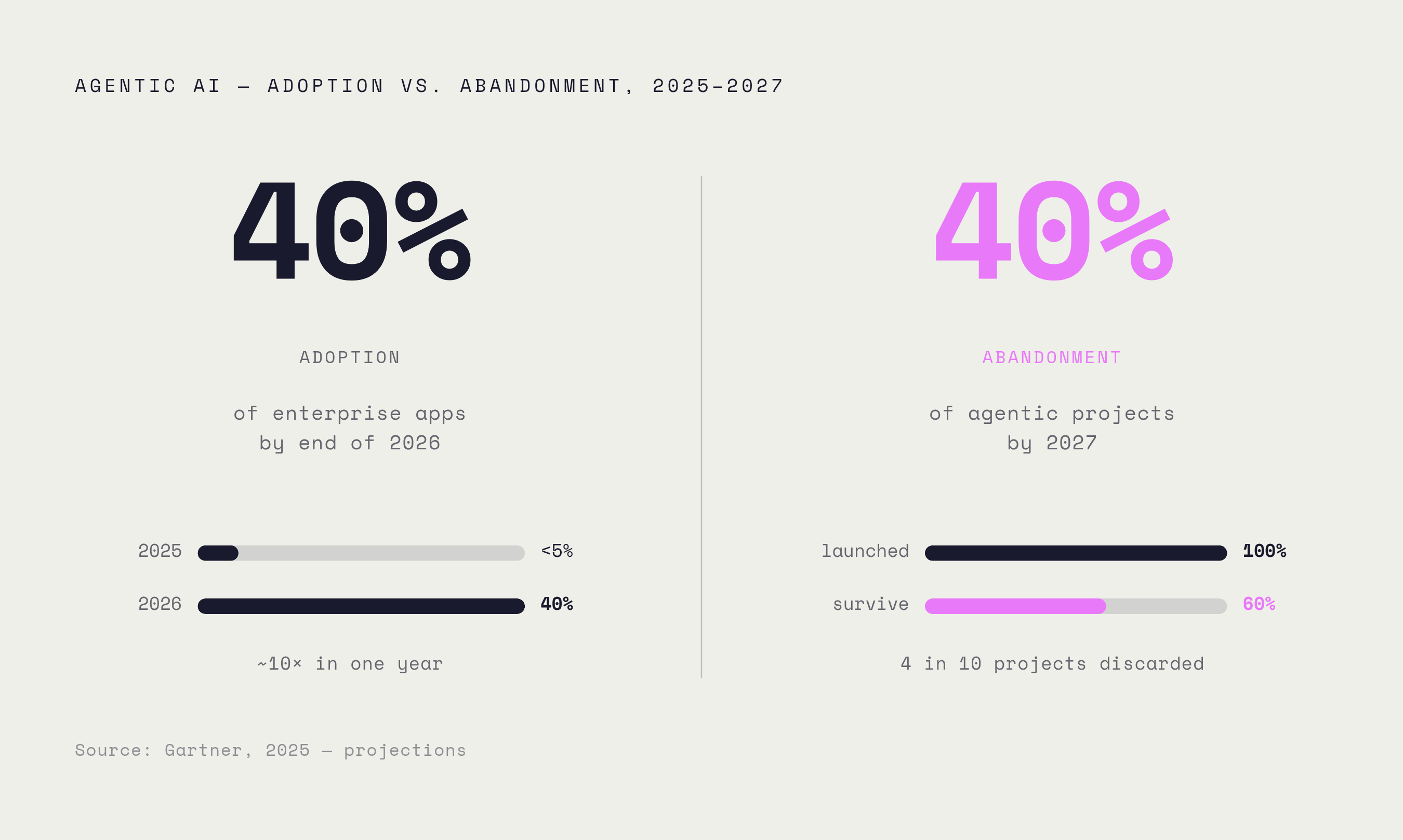
The enterprise AI market is projected to grow from a substantial base in 2026 to more than double that figure by 2031, a compound annual growth rate near 18.9%. The agentic AI segment, still small relative to the broader market, is valued at a modest sum in 2026 and projected to reach a figure many times larger by 2034, a 43.8% CAGR that outpaces almost every other category in enterprise software. Gartner projects that 40% of enterprise applications will include task-specific AI agents by the end of 2026, up from under 5% in 2025, growth that is vertical rather than incremental. That's closer to vertical growth than a growth curve. It's closer to vertical.
Set against that is a harder number: more than 40% of agentic AI projects are predicted to be abandoned by 2027, with high cost, unclear return, and complexity outstripping what teams budgeted for cited as the reasons. Reading the two forecasts side by side brings the real story into focus: enterprises aren't struggling because agents can't reason well enough. They're struggling because the systems built to run those agents in production don't survive contact with real infrastructure, real network partitions, and real multi-hour workflows. The adoption curve is a demand signal. The abandonment rate is an infrastructure signal, and closing that gap is an orchestration problem before it's anything else.
What Temporal is
Temporal.io is an open-source workflow orchestration engine built for exactly this failure surface, and its own term for what it provides is "durable execution." A workflow's state persists independently of any single process, so a crash doesn't erase progress. It just interrupts a system that already knows how to pick back up.
The company's history predates the current AI wave by nearly a decade. Its engineers previously built a system called Cadence inside Uber, and that work became the foundation Temporal was built upon. That work was open-sourced and forked into what became the Temporal Server, and a company formed around it to offer commercial support and a managed cloud version. Temporal has been explicit that as AI systems take on more autonomous, multi-step action across services, reliability becomes the binding constraint, and durable execution is its answer to that constraint.
The funding trajectory signals where serious capital thinks this problem sits. Multiple funding rounds have followed in succession, each at a larger scale than the last, drawing participation from prominent venture firms and reflecting how central orchestration has become to the AI infrastructure conversation, not a peripheral tooling concern.
The three-component model: workflows, activities, and workers
Temporal organizes business logic into three parts, and the separation between them is the whole point.
A Workflow is the overarching logic, the "what needs to happen." Processing an insurance claim end to end, coordinating a multi-agent research task, running a document pipeline from ingestion to summary: these are Workflows. An Activity is a single concrete task, the "how" of one step in that larger process: call a payment API, invoke an LLM, extract text from a PDF. A Worker is the process that actually executes the code, either Workflow or Activity, and it reports its progress back to the Temporal Service.
The design rule that matters most for AI workloads is where GPU-bound or LLM-bound work is allowed to live: in Activities, never in Workflow code. Get this backwards and durability collapses, because Workflow code has to stay deterministic and fast, a pure orchestration layer, while anything with a side effect, an inference call, a network request, a database write, gets pushed down into an Activity. In practice this means Workers come in two flavors. Workflow Workers poll for workflow tasks and run the deterministic orchestration logic, and they're cheap processes that need no special compute hardware. Activity Workers poll for activity tasks and run the actual compute. This includes the inference calls, the embedding generation, and the fine-tuning jobs, wherever the real cost and real risk of failure sit.
This division looks like an implementation detail. It's the precondition for everything durable execution does, because deterministic Workflow code is what makes replay possible.
Event history and deterministic replay as the mechanism for surviving crashes
An Event History drives every Temporal Workflow Execution: a complete, ordered log of everything that has happened in that execution, recorded by the Temporal Service itself. This log is the actual mechanism of durability, not a metaphor for it.
When Workflow code calls an SDK function to run an Activity or start a timer, the SDK doesn't touch the outside world directly. It records a Command. That Command gets sent to the Temporal Service once the current Workflow Task completes. The Workflow itself never touches a payment API or an LLM endpoint; it only produces instructions that get carried out elsewhere, and every one of those instructions is written to the Event History before it's acted on.
That's what makes crash recovery possible without any custom state-saving logic. If a Worker crashes, if the network drops mid-call, if the whole Temporal server restarts, nothing is lost, because the Service reads the Event History, replays the Workflow code from the beginning up to the last recorded point, and resumes exactly where it left off. The workflow was never actually "running" in the fragile sense. It was always a projection of its own event log, so restarting the infrastructure underneath it doesn't restart the business logic.
Four guarantees fall out of this design. State persists across crashes, pod restarts, and even region failovers, since the Event History, not the process, is the source of truth. Side effects execute exactly once: a tool call that already ran won't run again on replay, no matter how many times the workflow resumes, which directly closes off the duplicate-charge, duplicate-write failure mode named above. Workflows can suspend and resume across delays stretching from minutes to weeks, since waiting for a signal doesn't require holding a live thread or a live connection. And deterministic replay means the same Workflow code, re-executed from the same journal, always arrives at the same state, the property that makes the first three guarantees reliable rather than merely convenient.
What the determinism requirement demands from developers
None of this works without a hard constraint on the Workflow layer: Workflow code has to be deterministic, full stop. Replay depends on re-running that code and checking that the Commands it generates match what's already recorded in the Event History. If the code behaves differently on replay than it did the first time, the whole recovery mechanism breaks quietly, and this failure becomes visible only at the exact moment a team needs the recovery to work.
A handful of common patterns violate this without looking like they should. Making a network call directly inside Workflow code is one, since the result can differ between the original execution and the replay. Using unseeded randomness is another: two runs of the same "random" logic need to produce the same output, so any randomness either has to be seeded deterministically or moved out to an Activity. Reading the wall clock directly inside Workflow code has the same problem, since real time doesn't stand still for a replay. Time-dependent logic needs to go through Temporal's own timer primitives instead of a raw system call.
The rule that resolves all of this takes discipline to hold to, but it's simple to state: Workflows orchestrate, Activities do the side-effectful work. Anything nondeterministic gets pushed into an Activity, where it's allowed to behave unpredictably because Activities aren't subject to replay the way Workflow code is.
There's a practical ceiling here too. Temporal enforces a hard limit on Event History size, 51,200 events or 50 MB, with a warning threshold at 10,240 events or 10 MB. Long-running, high-frequency agent loops need to be designed around this ceiling, often by breaking a single sprawling Workflow into smaller child Workflows, since an Event History that grows unbounded will eventually hit a wall no amount of good architecture elsewhere can route around.
Human-in-the-loop, scheduling, and the agent interaction model
Human review is one of the harder things to bolt onto a stateless system. Waiting for a person to approve something might take five minutes or three days, and most infrastructure doesn't like holding a thread open for either outcome. Temporal treats this as a first-class case rather than a workaround: a Workflow can pause indefinitely, waiting on a signal, whether that signal is a human approval, a refreshed credential, or a clinician's sign-off, without tying up compute or risking a timeout while it waits.
A typical agent orchestration flow follows a fairly consistent shape. A user's request comes in as a signal, one or more Activities figure out the next step, the Workflow queries an LLM using the workflow's accumulated context when reasoning is needed, and if the agent needs more information or explicit permission before acting, it asks the user and waits. Once the user confirms, another signal arrives and the Workflow resumes exactly where it paused. Temporal also supports scheduled execution, so an agent can poll a data source at a set interval and act on what it finds, without a separate cron system bolted on the side.
Consider an insurance claims workflow that touches an EHR system, a clearinghouse, a document extraction step, an LLM for summarization, a human reviewer, and finally a billing platform. The human review step is the long pole in that process, potentially open for hours or days depending on reviewer availability. Most systems would need custom state machine logic just to track "waiting for review" as a status. In Temporal, it's a native wait on a signal, handled by the same mechanism that handles every other pause in the workflow, with no bespoke code required to keep the claim's state intact while it waits.
What the 2026 platform releases add for AI agent teams
Several 2026 announcements, spanning early-year GA milestones, the Replay 2026 conference held May 5 to 7 in San Francisco with more than 2,000 developers attending, and further updates in August, extend this model toward the bursty, latency-sensitive demands of agent workloads.
Serverless Workers are the biggest structural change, and the one most teams underestimate going in. Workers can now run on serverless compute, starting with AWS Lambda, and Temporal Cloud handles invoking, scaling, and shutting them down automatically based on how much workload is actually coming through. That removes a real planning burden: teams no longer need to guess at worker pool sizing for a workload that might spike ten-fold during a burst of agent activity and sit idle the rest of the time. A live demonstration at Replay 2026 processed roughly 60,000 conference attendee votes, peaking near 16,000 concurrent Lambda invocations, with automatic retries handling failures inline, for a total run cost under $3. For AI teams whose agent traffic is inherently uneven, that kind of elastic scaling cuts wasted infrastructure spend during idle periods while still absorbing sudden spikes without manual intervention.
Workflow Streams bring real-time streaming output into what has historically been a long-running, batch-oriented execution model. This closes a real gap: Temporal's durability guarantees were built for processes that might run for hours, while conversational agents need to stream partial responses back to a user within milliseconds. Workflow Streams lets a single system do both instead of forcing teams to bolt a separate streaming layer on top.
Standalone Activities, introduced in May 2026, let an Activity run independently rather than only as a step nested inside a Workflow. That's a smaller change on paper, but it opens up patterns where a single tool call, an embedding lookup or a one-off inference request, doesn't need the overhead of a full Workflow wrapped around it just to get Temporal's retry and observability guarantees.
Taken together, these releases are an acknowledgment of where the infrastructure gap for agentic AI actually sits: not in reasoning quality, but in the unglamorous work of keeping state alive, retries honest, and side effects f... They're an acknowledgment of where the infrastructure gap for agentic AI actually sits: not in reasoning quality, but in the unglamorous work of keeping state alive, retries honest, and side effects from firing twice, across processes that increasingly run for hours or days at a time.